

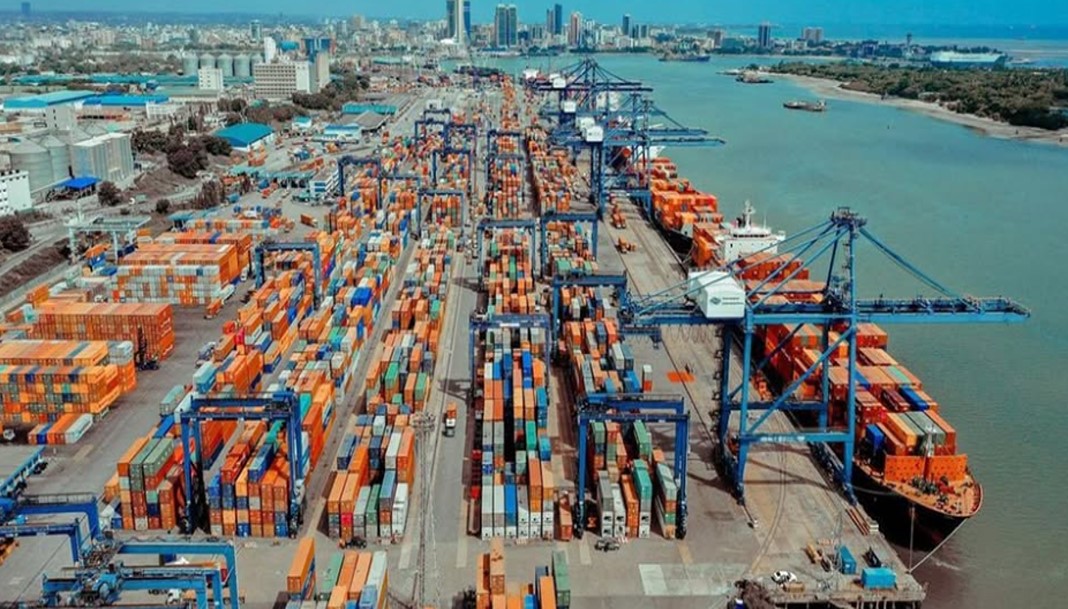
Dar es Salaam is consolidating its standing as the primary maritime entry point for landlocked markets across East and Central Africa. Driven by rapid efficiency gains, expanding infrastructure, and structural changes in supply chain preferences, the volume of transit cargo moving through Tanzania’s principal ocean terminal reached 14.61 million tonnes in the 2025/26 financial year a 17% increase year-on-year.
The surge underscores Tanzania’s pivotal role in regional trade corridors, with neighboring economies turning to the Indian Ocean gateway to safeguard supply chain predictability. The Democratic Republic of Congo (DRC) accounted for the lion’s share of transit traffic, registering a 30% jump to 7.77 million tonnes presenting over half of Dar es Salaam’s total transit throughput. Shipments bound for Zambia reached 3.41 million tonnes, while cargo destined for Rwanda grew by 24% to hit 2.18 million tonnes.
“Regional trade is fundamentally a battle of corridor efficiency,” said a regional supply chain analyst. “Mining conglomerates in the DRC and commercial importers across East Africa are actively re-routing freight based on door-to-door transit reliability, clearance times, and overall operational costs. The efficiency of the port must seamlessly extend all the way through to the final inland border post.”
Overall throughput at Dar es Salaam Port climbed 21.5% in 2025/26 to reach 33.71 million tonnes, up from 27.76 million tonnes in 2024/25 and 16.27 million tonnes in 2020/21. Turnaround times for container vessels have seen dramatic improvements, with average dwell times at berth dropping from approximately 10 days to just three days. Container traffic has repeatedly shattered historical benchmarks, logging consecutive monthly highs that culminated in 48,793 containers handled in August a stark contrast to pre-2024 monthly averages of 8,000 to 13,000 units.
Operational improvements have been underpinned by private sector concessionaire involvement and substantial capital expenditure. Terminal operator DP World injected $123 million into port infrastructure up to April 2026, delivering advanced cargo-handling systems, expanded gate capacity connecting to Nelson Mandela Road, and new container cranes. In June, eight new diesel-electric Rubber Tyred Gantry (RTG) cranes were commissioned to ease yard congestion.
“Reducing vessel turnarounds and modernising yard infrastructure has eliminated costly congestion surcharges that previously plagued ocean carriers,” noted a senior maritime logistics executive. “With larger vessel calls such as Ro-Ro carriers discharging nearly 7,900 vehicles in under 28 hours he port is demonstrating that it can handle complex, multi-modal cargo at scale.”
The downstream economic effects of this volume expansion are cascading across Tanzania’s broader logistics ecosystem. Transport firms, clearing and forwarding agents, railway operators, dry bulk handlers, and underwriters are experiencing heightened demand. Incoming dry-bulk handling capacity upgrades are projected to boost throughput for essential industrial commodities including wheat, sulphur, and fertilizer by 65%, reducing holding costs for domestic and regional agricultural producers.
To prevent inland bottlenecks from eroding port-side gains, Tanzania is executing an integrated corridor strategy combining rail, road, and dry port assets. Commercial freight operations on the standard gauge railway (SGR) between Dar es Salaam and Dodoma launched in July 2025, with further westward expansions underway alongside a planned rail-to-road freight hub in Morogoro. Meanwhile, the inland Kwala Dry Port designed for an annual capacity of 300,000 containers is actively staging transit cargo for landlocked partners, supplemented by the ongoing rehabilitation of the TAZARA rail line and road expansion projects at critical choke points like the Tunduma border post.
Digital administrative reforms are expected to yield further operational dividends. The Tanzania Shipping Agencies Corporation (TASAC) is preparing to rollout its Maritime Transport e-Regulatory System, replacing paper-heavy documentation processes with integrated digital licensing and compliance verification.
“Every additional day a truck sits idle at a border checkpoint ties up working capital in fuel, wages, and delayed inventory,” said an East African trade strategist. “Digital clearing tools coupled with physical corridor upgrades are essential if Tanzania is to convert higher cargo numbers into long-term commercial competitiveness against competing logistics corridors in Southern and Eastern Africa.”
